
How to Staff a Hotel for Operational Excellence
A hotel is not staffed by room count alone. Two properties with the same number of keys can require radically different teams. A 50-room hotel with a restaurant, laundry, airport transfers and event space may need more people per room than a 200-room select service property.
That is why successful operators do not ask, “How many employees should we have?” They ask, “What service promise are we making, what demand must we cover, and what skills are needed on every shift to deliver it safely and consistently?”
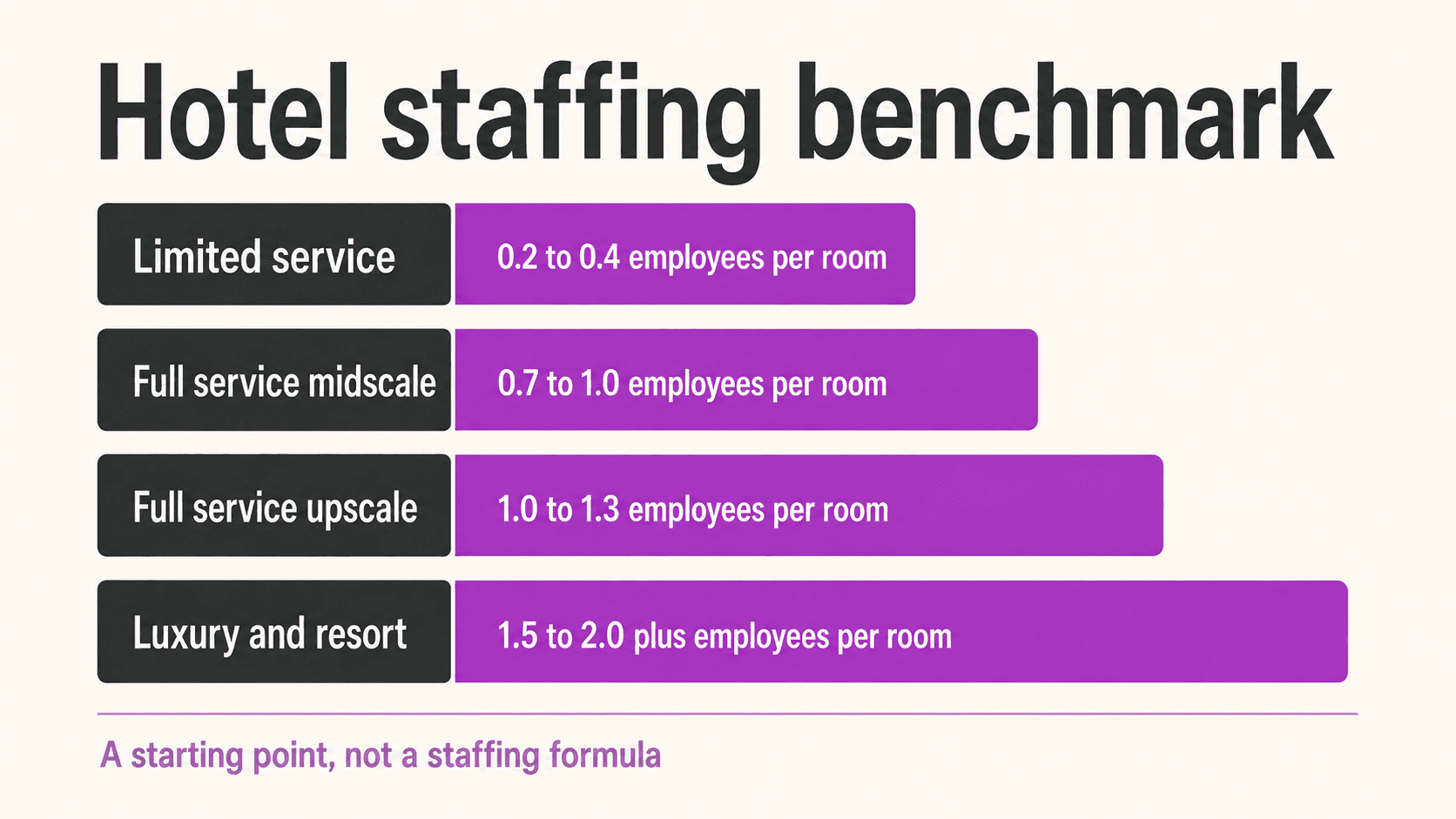
For full-service hotels, a useful first benchmark is around 0.7 to 1.0 employees per room. Upscale full-service hotels may need around 1.0 to 1.3 employees per room. Luxury and resort properties can require 1.5 to 2.0 or more employees per room.
These figures are planning ranges, not a substitute for a proper workforce plan. Amenity load changes the equation. A hotel with larger public areas, several restaurants, a spa and personalised guest services will need more people than a hotel with the same number of rooms but a simpler offer.
For a small full-service property, the benchmark can be useful. A 48-room hotel with 38 employees has a ratio of about 0.79 staff per room. A 28-room hotel with 20 employees has a ratio of about 0.71. Both sit within a credible range for a lean midscale full-service model, provided the team mix, shift coverage, and service standards are working.
Start with the service model, not the headline ratio
Ratios are helpful for a first sanity check. They become risky when treated as a staffing formula.
Five operational realities determine a hotel’s labour or staff requirement.
Rooms demand: occupancy, arrivals, departures, length of stay, room type mix and stayover cleaning policy.
Service promise: twenty-four-hour reception, concierge, in-room dining, turndown service, bell service, valet, laundry, transport and guest recovery all require people.
Amenity load: restaurants, bars, banquet halls, spas, pools, gyms, gardens and staff accommodation create work that room count alone cannot reveal.
Demand pattern: weekday corporate peaks, weekend leisure traffic, group arrivals, events and seasonality must be staffed differently.
Local labour market: wage levels, skills supply, commuting time, regulation and retention risk vary by city and country.
The objective is not to minimise headcount. It is to build enough capability to deliver the promised experience at a sustainable cost.
The measures every general manager should track
A staffing dashboard should combine a broad ratio with live operating measures.
Employees per available room provides a useful comparison between similar properties.
Labour hours per occupied room shows how much productive labour is needed as occupancy, arrivals and departures change.
Labour cost per occupied room helps managers assess whether the hotel is converting labour spend into service and revenue.
Track these measures monthly, then review them by department and by day of week. A hotel can look efficient on paper while its front desk is overwhelmed at check-in or its housekeeping team is unable to release rooms on time.
Guest satisfaction, room readiness, overtime, absenteeism and turnover should be reviewed alongside labour cost. Leaner staffing is not always more productive staffing.
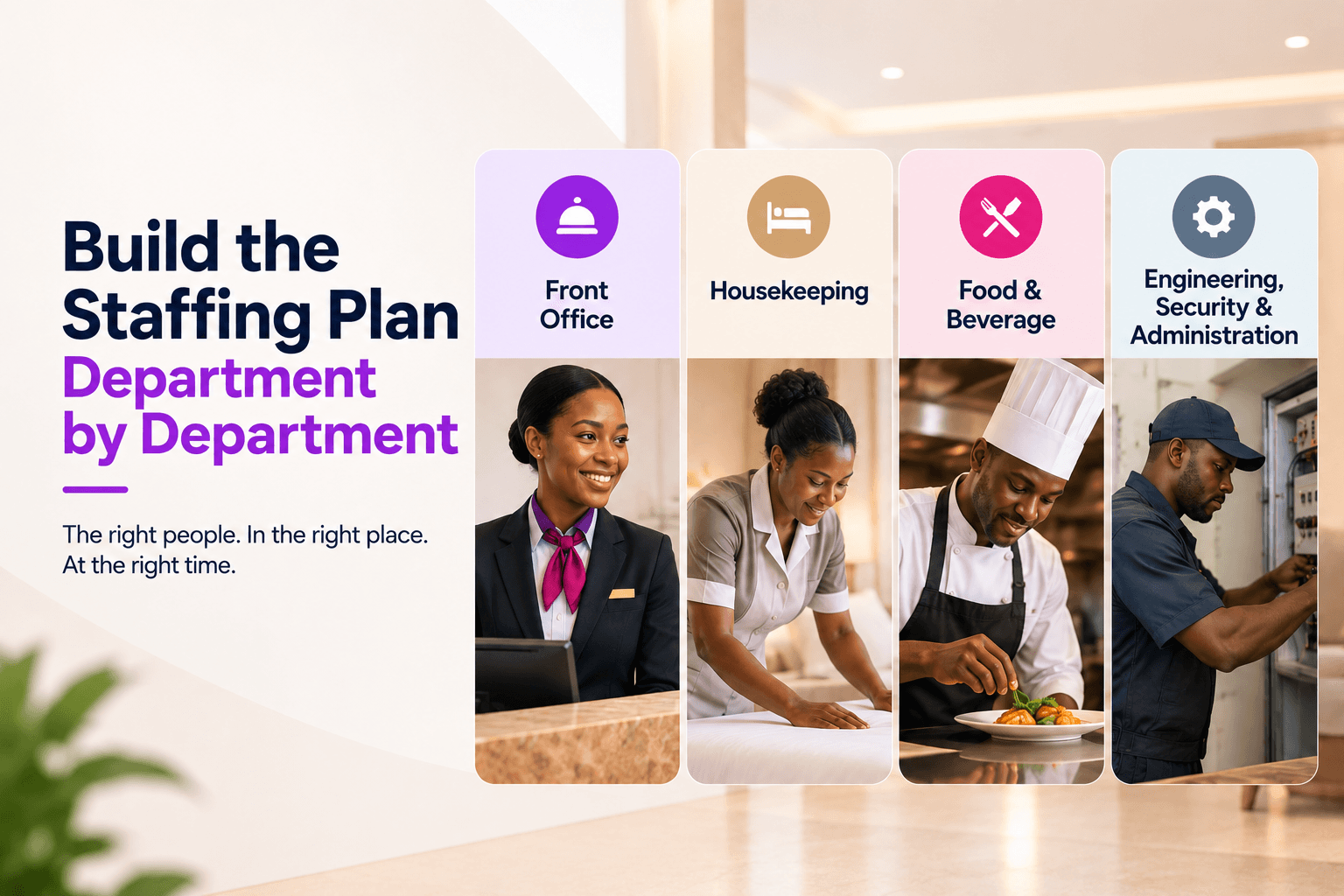
Build the staffing plan department by department
Reception staffing should be planned around arrival and departure waves, not only a fixed number of people per shift. Map arrival forecasts by hour, group movements, airline schedules and local traffic conditions.
A quiet night shift may be safely handled by a night auditor and security coverage. A busy afternoon may need a manager, several receptionists, guest relations support and bell or transport assistance.
Cross-training is valuable, particularly in smaller hotels. However, it should not become an excuse for one person to perform multiple critical roles during a rush. A receptionist can support reservations in a quiet period, but cannot reliably manage a queue, a payment issue, a guest complaint and an emergency alone.
Housekeeping
Housekeeping is often the first place where poor staffing decisions become visible to guests.
Daily room attendant assignments should consider departures, stayovers, room size, expected check-in times, maintenance needs, linen capacity, public area cleaning and evening service where offered. A departure room has a different workload from a stayover room. Suites require more time than standard rooms. Supervisors also need capacity to inspect rooms, coordinate room readiness and coach the team.
When supervisors spend the whole day cleaning rooms, quality control and training disappear. When rooms are released late, reception carries the pressure. When reception carries the pressure, guest satisfaction suffers.
Food and beverage
Restaurants, bars, breakfast operations, banquets and room service should each have their own staffing logic. Forecast covers by meal period, event guarantees, menu complexity, kitchen production requirements and opening hours.
A hotel with full breakfast, all-day dining and regular events should not apply the staffing model of a property with breakfast only. The key question is simple: can the team serve the forecasted volume without compromising food safety, speed, presentation or guest connection?
Engineering, security and administration
Maintenance staffing depends on property age, building systems, pool or spa facilities, generators, water treatment, lifts, kitchen equipment and preventive maintenance discipline.
Security coverage should reflect the local risk environment, event activity, cash handling and guest movement. Finance, sales, human resources, procurement and technology may be shared across a small portfolio, but each area still needs clear ownership.
Staffing differs by property category and city
Limited service hotels can operate with leaner ratios because the guest offer is simpler. Full-service midscale hotels need deeper teams across front office, housekeeping, food and beverage, maintenance and management.
Upscale city hotels carry a higher expectation of speed, discretion and personalisation. Corporate guests often arrive in compressed peaks and expect reliable wireless internet, accurate invoicing and rapid issue resolution.
Resorts and luxury hotels are service intensive by design. Multiple outlets, spa and recreation services, extensive grounds, transport, children’s activities, concierge support and guest recognition all create labour demand.
City centre hotels experience concentrated arrival and departure peaks. Airport hotels need resilience around late flights and disrupted travel schedules. Event hotels need banquet, culinary and service capacity that can flex around the calendar.
A resort may need more employees per room, while an urban hotel may need more people at specific hours. Both can be well staffed if the plan matches the operating rhythm.
Developed, developing and emerging markets
A global benchmark should be a starting point, never a prescription.
In developed markets, hotels often face high wage costs, skills shortages, housing constraints and tighter rules around overtime. The practical response is stronger forecasting, stable rosters, retention, training and smart use of technology.
In developing and emerging markets, labour may be more available, but the operating context can be more complex. Hotels may need additional support for staff transport, private security, power backup, water treatment, in-house laundry and broader guest assistance.
Skills supply, formal training access, public transport and retention can also be uneven. A lower wage bill should never be mistaken for a sustainable staffing advantage.
The strongest operators hire for attitude and service potential, invest in training, create visible career paths and build fair working conditions into the operating model.
Where Quickrooms fits into the staffing conversation
A staffing plan is only valuable when hotel leaders can act on it in real time. Many properties still manage rosters, staff attendance, room status, guest requests, maintenance tasks and stock needs across separate tools, paper records and informal messages. This leaves managers with partial information and teams with unclear priorities.
Quickrooms brings these operational activities into one connected hotel operating system.
With Quickrooms, managers can oversee staff rosters, shifts, clock-in and clock-out records, work reports, housekeeping activity, guest services, food and beverage workflows and supply management from one place.
This matters because staffing pressure changes throughout the day.
When occupancy rises, arrivals build, rooms are not ready, guest requests increase, or an event is scheduled, hotel leaders need to see the pressure early. They can then redeploy people, adjust shifts, strengthen a department or identify where training is needed.
Quickrooms does not replace hospitality professionals. It gives them clearer information, stronger coordination and more time to focus on the guest.
The operational excellence test
Your staffing model is likely working when rooms are released on time, guests are greeted quickly, restaurant and banquet service meets its promised standard, and employees understand their responsibilities on every shift.
It is also working when managers spend more time coaching teams and improving operations than filling urgent gaps in the roster.
For a full-service hotel, a broad starting range of 0.7 to 1.0 employees per room can be sensible. The final number should be earned through the hotel’s service model, outlet complexity, demand pattern and local market realities.
Get those inputs right, connect the team through Quickrooms, and staffing becomes more than a budget line. It becomes one of the clearest competitive advantages a hotel can build.