
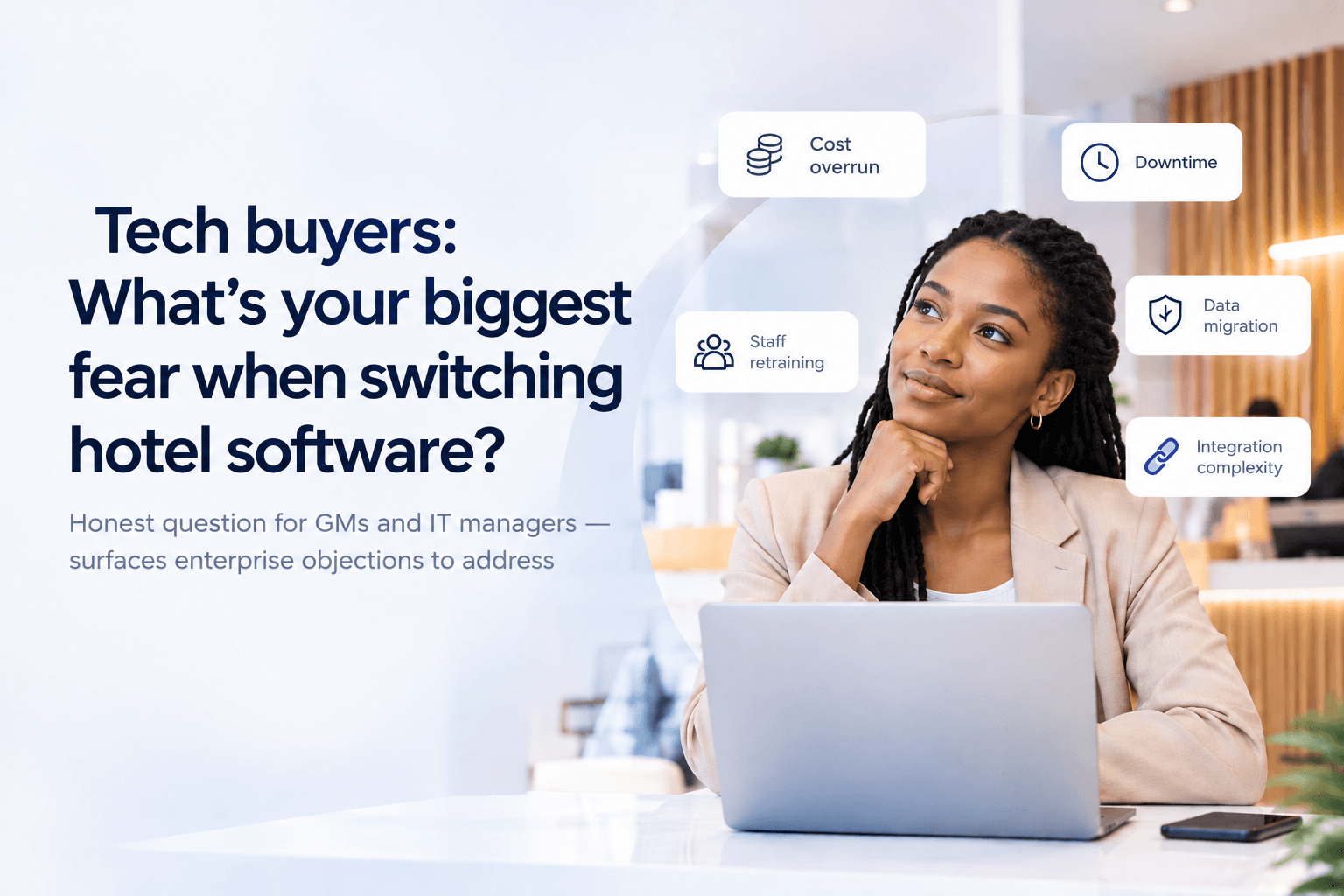
What's Your Biggest Fear When Switching Hotel Software?
Most hotel leaders know when their software is holding them back. The front desk works around it. Reports take a day to pull together. Staff keep a spreadsheet on the side because the system can't do what they need.
And still, many hotels stay put. Not because they love their current system, but because switching feels like a leap in the dark.
If you're a general manager or an IT manager, you have probably felt it. So we want to ask you directly: what is your biggest fear when switching hotel software?
Data migration
Staff retraining
Downtime
Cost overrun
All of these
These fears are reasonable. In HotelTech Report's 2026 PMS Impact Study, a survey of 450 experienced hotel professionals, 26% named staff training as the biggest barrier to switching, and 24% named data migration as their top concern. Below, we take each fear in turn: why it's real, and what actually reduces the risk.
Fear 1: "We'll Lose Our Data"
Your guest history, future reservations and financial records are years of work. The worry that they won't survive the move is natural.
The good news is that most core records move well. Guest profiles, stay history and future reservations usually transfer with some mapping work. The trouble spots are more specific. As Cloudbeds' implementation guide notes, free-text guest notes, custom billing rules and unusually formatted old folios often need a manual check. Hotel Tech Insight adds that card payment tokens rarely move between payment providers, so some guests may need to re-confirm their card.
What reduces the risk:
Clean before you move. Merge duplicate guest profiles, remove test bookings and fix room-type names first. Clean data in means clean data out.
Test on a sample. Run a trial import on part of your data and check profiles, reservations and balances before the real move.
Archive what won't move cleanly. Keep old folios as a read-only export, so nothing is ever truly lost.
Fear 2: "My Team Will Struggle to Learn It"
This was the most common worry in the HotelTech Report study. Hotels have busy teams, high staff turnover and no spare weeks for training. A system that confuses the front desk can hurt guests on day one.

Modern software has changed this picture. In the same study, 92% of hoteliers said modern PMS interfaces dramatically reduce staff training time, shrinking onboarding from weeks to days.
What reduces the risk:
Train by role. The front desk, housekeeping and accounts need different things. Short, role-based sessions beat one long demo.
Practise before go-live. Let staff try real tasks in a test version of the system before guests are involved.
Name a champion. One person on site who knows the system well, plus a one-page cheat sheet for the first week, answers most questions before they become problems.
Fear 3: "We Can't Afford to Go Offline"
A hotel never closes. Guests check in at midnight, bookings arrive from online travel agents around the clock, and nobody wants a front desk that can't find a reservation.
Downtime is mostly a planning problem, not a software problem. The riskiest approach is a "cold switch": turning the old system off and the new one on overnight with no fallback.
What reduces the risk:
Pick a quiet window. Go live mid-week in a low-occupancy period, away from events, groups and long weekends. Hotel Tech Insight notes that many operators choose a Tuesday or Wednesday night.
Keep a safety net. Run the old system in read-only mode for a short overlap, so staff can check anything that looks wrong.
Get the essentials right first. On day one you need booking channels, payments, rooms and rates, and check-in and check-out. Extras like custom reports can follow a week later.
Choose cloud software. Cloud systems update without the scheduled maintenance windows older, on-site systems need.
Fear 4: "It Will Cost More Than We Planned"
Technology projects have a reputation for running over budget, and it is earned. Research by McKinsey and the University of Oxford, covering more than 5,400 IT projects, found that large IT projects ran 45% over budget on average. A hotel software switch is far smaller, but the same traps apply: costs nobody mentioned at the start.

In hotel software, the surprises usually come from setup and data migration fees, extra modules sold separately, card processing charges and the staff hours spent on the move.
What reduces the risk:
Ask for a full first-year quote. Setup, migration, training, add-ons and payment fees, all in writing before you sign.
Count the time, not just the money. Budget the staff hours for data cleaning, training and go-live week.
Prefer terms that keep the vendor accountable. Monthly or quarterly payment, rather than one large upfront fee, means the vendor has to keep earning your business.
"All of These"
If you ticked every box, you're not alone, and you're not wrong. The four fears are linked. Rushed data migration causes downtime. Poor training creates errors that cost money. The answer is the same for all of them: a plan, made before you sign.
A simple switching checklist:
Our data is cleaned, and a test import has been checked.
Staff have practised their own tasks before go-live.
Go-live is set for a quiet mid-week window, with a fallback.
We have a full first-year cost in writing.
There is one clear contact when something goes wrong.
How Quickrooms Approaches the Switch
Quickrooms is a hotel operating system with property management built in, so your front office, housekeeping, staff, stock and channel connections run on one platform instead of several. Fewer separate systems means fewer things to migrate, fewer screens to learn and fewer moving parts on go-live day.
We offer Quickrooms on monthly or quarterly subscriptions instead of one-off payments. That keeps us accountable every month, which is the best protection against the fear of paying for software that doesn't deliver.
Tell us your biggest fear. Vote in our poll on LinkedIn or X, or bring your questions to a demo. We'll walk through your current setup and how a move would work for your hotel.
Quickrooms. Your smart hospitality AI operating system. Book a demo today.
Read More Related Articles
Quickrooms Integrations: Connecting the Tools You Already Use
Why Hotel Tech Ecosystems Fail, and What to Look For in a Platform Partner
Sources
2026 Hotel Property Management Systems Impact Study, HotelTech Report (survey of 450 hotel professionals).
Hotel Management Software Implementation: Step-by-Step Guide, Cloudbeds.
Maciej Dudziak, Hotel PMS Migration 2026: 7-Step Guide, Hotel Tech Insight, 17 April 2026.
Michael Bloch, Sven Blumberg and Jürgen Laartz, Delivering large-scale IT projects on time, on budget, and on value, McKinsey, October 2012.
Photos via Pexels.